

CASE STUDY
How the Brooklyn Museum reclaimed 45 hours a month
Like many nonprofits, the Brooklyn Museum was short on time.
Through Decoded Futures, the development team learned how to build AI tools that eliminated hours of repetitive administrative tasks, freeing capacity for the work that matters most: strengthening donor relationships and growing philanthropy.
Before Decoded Futures
The Brooklyn Museum development team spent roughly 45 hours each month manually producing donor acknowledgement letters and fundraising reports.
With Decoded Futures
Staff built two AI assistants — one to generate gift acknowledgement letters and another to automate quarterly fundraising reporting — while learning how to iterate prompts and design workflows around their own processes.
After Decoded Futures
The team reclaimed those 45 hours every month and is expanding AI beyond development, launching staff training, developing an AI policy, and identifying new opportunities across the institution.
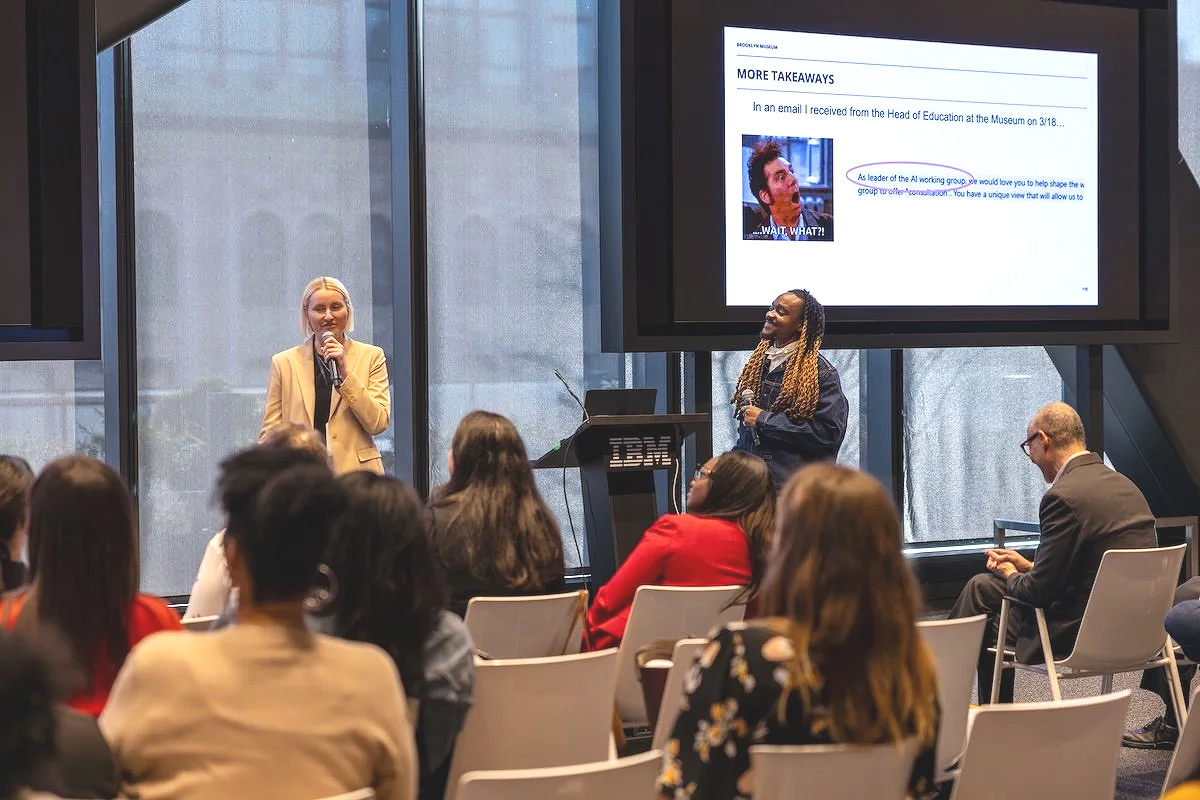
No nonprofit can get by without administrative tasks, but they often crowd out the strategic work that drives impact and growth. This was the challenge facing Danielle Piendak and D’Ante Dukes at the Brooklyn Museum — one of the country’s oldest and largest art museums, and one with pay-what-you-can admission to more than 650,000 visitors a year. Their fundraising team was caught in a cycle of manual spreadsheets, repetitive reporting, and highly customized donor communications.
Through Decoded Futures’ eight-week initiative, Danielle and D’Ante worked with a volunteer technologist to build two custom AI assistants: one trained on detailed SOPs and letter templates to generate donor acknowledgements, and another to transform raw data exports into quarterly fundraising reports. Both tools were built to capture staff expertise that was used in these repetitive tasks — embedding the team's own knowledge, processes, and judgment into repeatable workflows that staff could review and refine.
Photo: Bashir Abdulkareem
“Our big call to action after our participation in this program is to think about how AI can influence the Brooklyn Museum’s work.”
— Danielle Piendak, Director of Development Revenue & Strategy, Brooklyn Museum

The impact extended well beyond two automations. Since Decoded Futures, Danielle has become the Brooklyn Museum’s informal AI lead, helping shape staff training, a summer AI Institute, AI governance, and future use cases across the institution. What started as a project to reclaim 45 hours a month has evolved into a broader culture of innovation, one that is helping the Brooklyn Museum build capacity across the entire organization.
Here at the epicenter of AI for impact, Decoded Futures is equipping social sector leaders with the tools, networks, and skills to use AI to scale their impact and better serve all New Yorkers. Watch the Brooklyn Museum at the Decoded Futures Demo Day (below) to see how the organization used AI to build capacity and deepen their impact.
Demo: How to reclaim 45 hours a month
At the Decoded Futures Demo Day, showcasing highlights from the AI solutions built by 20+ social sector leaders over eight weeks, the Brooklyn Museum development team’s Danielle Piendak and D’Ante Dukes share their custom AI tools, what worked, what didn’t, and what comes next.
Find more case studies of AI in the social sector here.
Follow along on LinkedIn here.